
Virtual Humanism

The Collective Imagination as a Tool of Mass Conditioning
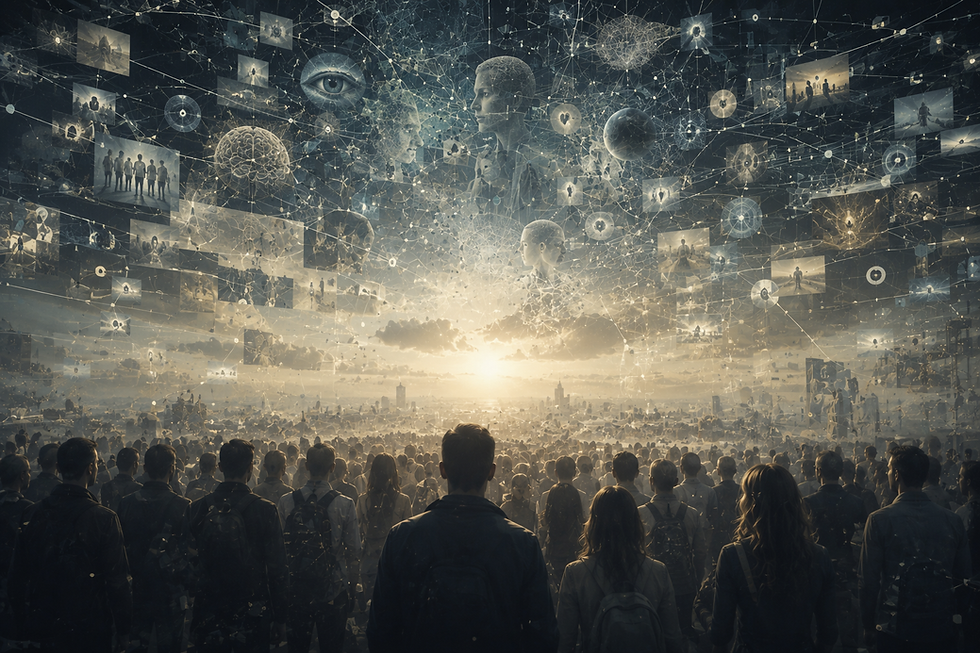
The Question of Our Time. Reality as a Predetermined Configuration
Social reality is no longer a simple given. Objectivity has progressively given way to the narration of the world and the social dynamics that surround us. Today, reality is better understood as a configuration of multiple elements situated between the true, the false, and what we might call the “half-true.”
Today, reality is a configuration in which the line between what is real and what is narrated has almost completely disappeared. What is narrated becomes part of the global narrative, not of individual truth. What we call the “world” does not present itself to us as raw, neutral, self-evident matter. It is always offered through a web of meanings that makes it interpretable.
Every society inhabits this web in the same way one inhabits a climate: without constantly perceiving its presence, yet depending on it completely. This means that we live in a time in which a symbolic infrastructure exists that precedes events. Not in a chronological sense, but in a structural one. Before something can be recognized as a fact, it must be capable of being understood; before it can be judged, it must appear plausible; before it can be accepted or rejected, it must fall within the horizon of what can be conceived.
This is the infrastructure that today establishes the thresholds of reality, defining, without our awareness, what can be named, what can be seen, and what can be believed.
We may call this space the Noosphere. Not a mystical space, not a spiritual metaphor, but today an operational environment. It is the place where information, attention, and emotion condense until they become a shared structure. It is the point at which the dispersed flow of data is transformed into a commonly perceived world.
The Noosphere should not be understood as a simple container of ideas: it is a configurational device. It organizes collective perception along a specific narrative thread, distributes intensity, and establishes priorities. Some elements are illuminated, while others remain in the shadows. Some acquire symbolic density, while others dissolve into indifference, yet all contribute to forming what we may define as contemporary social reality.
Social reality, therefore, is not what happens in a neutral way. It is what succeeds in stabilizing itself within this invisible infrastructure. It is what receives sufficient cognitive and emotional energy to become consolidated as shared evidence.
To understand the Noosphere means understanding that contemporary reality is the result of a process of symbolic condensation that transcends symbolism itself and re-enters the individual's perception of reality. And every society, consciously or not, lives within this architecture that precedes it, guides it, and defines the horizon of what is possible.
All of this should lead us to the inevitable reflection that we live in an age in which the symbolic environment precedes direct experience. We do not inhabit only cities, economies, and institutions: we inhabit narratives. Thus, the collective imagination is no longer merely a cultural framework; it has become the structuring infrastructure of social reality. Digital technologies did not create this dynamic, but they have accelerated it, systematized it, and automated it.
Today, power depends on the idea of reality that is created through mass narrative, which is something very different from truth.
Every theory of power is born from an unspoken assumption: an idea of reality. There is no power that does not imply a metaphysics, even when it claims to have none. For centuries, we have thought of power as the administration of matter: control of resources, management of force, governance of institutions. Within this framework, reality was a stable backdrop, an external and coherent given upon which authority intervened like an architect working on a building already constructed; the world was decipherable.
But this "reassuring" and mechanical image no longer holds in the contemporary world. It has lost its credibility and its basis in certain and interpretable elements.
Today we live in the "informational" age. Social reality no longer coincides strictly with what happens. It coincides with what is made visible, with what can be thought, with what succeeds in stabilizing itself as a shared configuration. The conflict no longer concerns only the distribution of matter, but the very conditions that allow something to emerge as real for a community, even when in fact it is not.
Thus, collective reality must be deciphered as a field of multi-configuration. What I previously called the Noosphere, as an operational environment in which the multiple manifestations of information, attention, emotion, memory, deductive and inductive perception are transformed into a structure of collective thought, generates individual perceptions that are already contaminated by the global narrative thread moving toward precise and predetermined objectives: mass conditioning.
Thus, the Noosphere becomes the place where perceptual energy condenses into thought, where what receives attention tends to stabilize itself, while what loses attention slips into irrelevance. In such a scenario, information becomes reality when it coagulates into symbol. And symbol becomes perceived order when it receives widespread recognition (everyone believes it, therefore it must be true). Contemporary power operates precisely at this level.
Its primary objective is no longer to govern "things," but to govern the architecture of attention.
Today, true power lies in the ability to determine what may appear and what must remain background noise. Its principal lever is not to allow the masses to construct decisions, but to configure possibilities that have already been predetermined. This means that it is no longer the individual's deterministic consciousness that filters choices; instead, it is limited to observing and choosing from a "menu" already written by others.
In this context, so-called "individual thought" becomes an archaic residue to be relegated to the peripheries of irrationality. This is because the collective mind is capable of producing extremely powerful correlations, polarizations around specific scenarios, as well as all-encompassing figures. An emblematic example lies in answering the question: why do I follow an influencer on social media when my consciousness perfectly understands the influencer's objective? One possible answer is that, within the collective narrative, the influencer reduces uncertainty by transforming fragments into a coherent narrative.
The influence constantly presented to us today rests on the ability to intervene in deep symbolic structures, drawing us into a reassuring and ephemeral collective environment that feeds itself through collective credulity, which in turn generates models to follow. And these are, in fact, the models that most people follow.
This is why the models presented to us are always successful and reassuring, never degenerative: because collective fear is not an anomaly of the system but has become one of its structural resources for mass control. Every civilization possesses its own instruments of symbolic stabilization, but today these instruments are networks, platforms, dissemination systems, and algorithmic architectures. They do not merely impose content: they modulate intensity, accelerate correlations, and saturate attention to the point of eliminating the persistence of emotional conflict.
Those who experience emotional conflict live consciously; this is precisely what mass narrative and the mechanisms of the new power of mass conditioning do not want. They do not want conflict because conflict would generate the need for reflection and therefore risk a greater dispersion from the narrative flow that is intended to be imposed. And even if a fracture were to emerge within the dominant narrative, information saturation, the dispersion of attention, and narrative recoding demonstrate the system's capacity to reabsorb symbolic tension. The event is absorbed, neutralized, and redistributed as noise.
This work advances a precise thesis: contemporary domination is exercised not primarily through material coercion, but through the scientific manipulation of the collective imagination. To govern means to intervene in the invisible architecture that determines what can become real. To understand this architecture means to understand where the fundamental conflict is being played out today: not only in public squares or parliaments, but in the space where attention is organized, where symbols are stabilized, and where the possible is authorized to exist.
From the Classical Noosphere to the Algorithmic Noosphere
The classical Noosphere was conceived as a progressive stratification of consciousness. An emergent field generated by the real interaction of human minds and experiences. Today, it has been transformed into a distributed computational environment in which:
information is the primary ontological material;
algorithms are devices for configuring reality;
collective perception is mediated by invisible architectures.
Language models, predictive systems, recommendation engines, and systems that utilize language based on instinctive neuro-perceptual parameters actively participate in the construction of perceived reality. They do not merely interpret the world: they shape its phenomenological form.
Social reality becomes the result of a globalized ranking of preferences generated through extremely vast grouping algorithms, which are themselves filtered and amplified. The narrative code is no longer interested in describing the world as it is, but in making visible what can be believed or perceived as real.